Master Free-Motion Quilting with Practical Exercises
There’s a moment in every quilter’s journey when you want to move beyond straight lines and echo quilting. You see those beautiful, flowing feathers, intricate geometric fills, and playful stippling in others’ work, and you think, “I want to do that.” The gap between that desire and confident execution often comes down to one thing: muscle memory. This is where dedicated quilting exercises become your most valuable studio companion, transforming hesitant practice into fluid, joyful creation.
Why Your Brain and Hands Need a Workout Plan
Free-motion quilting (FMQ) is a unique skill. It requires you to control the fabric’s movement in all directions while your sewing machine runs at a consistent speed. It’s like learning to drive a car while simultaneously drawing a complex map. Without practice, the results can feel shaky and unpredictable. The objective of these structured patterns is to build that coordination systematically. They aren’t just pretty designs; they’re targeted drills for your hands and eyes.
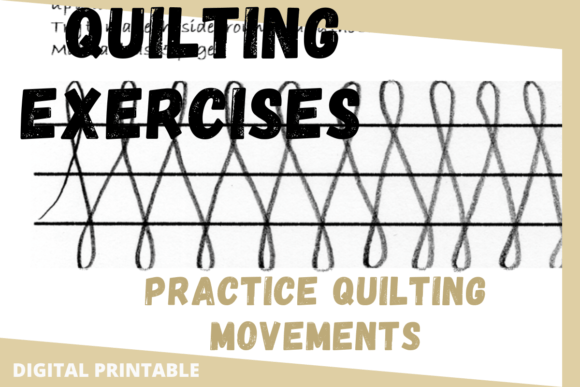
Think of these printable quilting diagrams as a workbook. Each sheet isolates a specific movement—a continuous curve, a sharp point, a smooth spiral, or a flowing vine. By tracing these shapes with a pencil on paper first, you’re teaching your brain the pathway. You’re building the neural connections before you even thread your machine. This deliberate practice is what separates frustrating attempts from confident stitching. It’s the difference between hoping for a good outcome and engineering one.
The Anatomy of an Effective Quilting Exercise
Not all practice is created equal. Effective quilting exercises have a few key characteristics that make them powerful learning tools. First, they focus on repetition with variation. You might practice the same basic “C” shape or loop, but in different sizes and directions. This builds versatility. Second, they encourage continuous line movement. Learning to navigate a design without breaking your thread is fundamental to efficient FMQ.
Third, they use clear visual guides. A well-designed exercise sheet will have bold, dark lines that are easy to trace. The spacing is intentional, giving you room to practice without feeling crowded. Some sheets even include starting points or directional arrows to guide your flow. Using colored pencils to trace these patterns isn’t just for fun—it’s a strategic way to visualize your path and mark your progress. A green pencil for the first pass, a blue for the second, and you can literally see your improvement over time.
Integrating Practice into Your Creative Workflow
For designers, bloggers, and content creators in the crafting space, these exercises offer more than personal skill development. They provide a wealth of authentic content. Imagine filming a time-lapse of your tracing practice, showing the progression from shaky lines to smooth, confident strokes. These behind-the-scenes glimpses resonate deeply with an audience because they showcase the real work behind the finished product. It’s content that builds connection and credibility.
For small business owners selling handmade goods or offering quilting services, this disciplined practice directly impacts your product’s quality and your brand’s professionalism. Consistent, beautiful stitching is a hallmark of a premium craft. It elevates a simple quilt into a work of art, just as choosing the right typeface elevates a design project. In the world of quilting, your stitchwork is your font. A clean, consistent stitch is like a classic sans serif font—it communicates clarity and reliability. A free-flowing feather motif can act like an elegant script font, adding personality and flair. Mastering these patterns through exercise ensures your “typography” is always on point.
From Paper to Fabric: Bridging the Gap
The true test comes when you move from paper to your quilt sandwich. The muscle memory you’ve built will kick in, but the feel is different. The fabric has drag, the thread has tension, and your machine is humming. This is why the exercises are designed to be easy to follow. You start with the most fundamental shapes—the ones that form the building blocks of nearly every quilting motif.
Practice on a small “practice sandwich” first. Use a plain muslin top and a simple cotton batting. This isn’t about creating a masterpiece; it’s about transferring the motion. Focus on maintaining an even speed with your foot pedal and a smooth, relaxed grip on your fabric. The goal is rhythm. When you hit a snag, don’t get discouraged. Go back to the paper, trace the difficult section again, and then try it on fabric. This iterative process is how you build visual hierarchy in your quilting—defining what areas pop and what areas recede through stitch density and scale, all guided by the foundational shapes you’ve practiced.
Choosing the Right Tools for Your Journey
Just as a designer selects a premium font for a key project, you should choose high-quality practice materials. Look for quilting exercise PDFs that offer a variety of patterns, from basic to more advanced. The best ones will include both display patterns (large, bold motifs for borders and medallions) and filler patterns (smaller, repeating textures for backgrounds).
Consider how these patterns might fit into your broader work. A set that includes modern, geometric shapes might be perfect for logo design inspired quilts or contemporary packaging design projects. A collection with organic, floral vines could complement a vintage aesthetic or editorial design for a craft publication. Think of these exercise sheets as part of your essential design assets library. They are the drills that keep your creative skills sharp, ensuring that when you sit down to create a brand identity piece or a social media graphics quilt for your shop, your technical execution is as strong as your creative vision.
Ultimately, these quilting exercises are about more than just making pretty stitches. They are about building confidence, developing a personal style, and investing in your craft with the same rigor a typographer gives to mastering letterforms. It’s a practical, hands-on approach to skill development that pays dividends in every quilt you create. So print out a sheet, grab your colored pencils, and start tracing. Your future self—and your future quilts—will thank you for the practice.